
SANTA CLARA, Calif.--(BUSINESS WIRE)--
The following is an opinion editorial provided by Kathy Winter, vice president and general manager of the Automated Driving Solutions Division at Intel Corporation.
This Smart News Release features multimedia. View the full release here: http://www.businesswire.com/news/home/20170510006328/en/
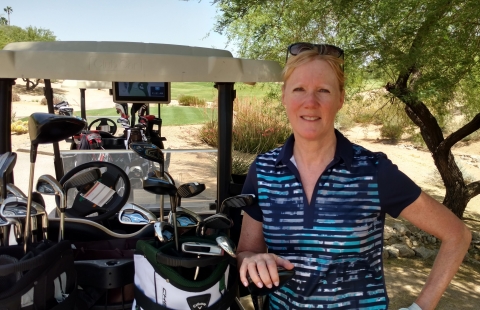
Kathy Winter, vice president and general manager of the Automated Driving Solutions Division at Intel Corporation, writes: "Just as you need different clubs to get you through 18 holes of golf, you need different kinds of processors to 'drive' an autonomous car." (Credit: Intel Corporation)
Golf is one of my favorite pastimes and despite my very high handicap, I enjoy both the mental and physical challenge of the game. It takes a certain amount of strategy and creativity to decide which clubs to use along the way. Some shots are fairly obvious: a driver off the tee, a wedge for the sand trap or a putter for the green. Others require a bit more ingenuity, such as a 3-iron to punch out from under a tree. I like to think of my bag of clubs as my golfing toolkit – each club chosen to provide optimal performance and power for the circumstances. My bag of clubs also provides a useful analogy for thinking about Intel’s approach to autonomous car design.
Just as you need different clubs to get you through 18 holes of golf, you need different kinds of processors to “drive” an autonomous car. Take sensors as an example. Each type of sensor generates a very different kind of data: cameras generate pixels, LIDAR generates point clouds and RADAR generates analog waveforms. All of these data types need to be processed differently. And if you were developing an autonomous car brain, you would choose very specialized tools perfectly suited to each data type rather than a single gaming processor for all of it.
The same is true for artificial intelligence inside the car. We often hear that the role of artificial intelligence (AI) in autonomous cars is for “computer vision,” and that a specific kind of computing element can be used for all AI in autonomous driving. But that’s an incomplete picture of the challenge.
Artificial intelligence is much more than computer vision and is, in fact, used throughout the driverless car to do everything from natural language processing to personalization to decision-making. Those are all very different kinds of AI, each with very different and unique computing needs. So instead of choosing one processor for all of the artificial intelligence tasks in the car, you need a processing toolkit with computing elements designed for each of those very different tasks.
Similar to how golfers need a full bag of clubs to play the game, autonomous car designers need a suite of computing technologies to engineer an autonomous car brain.
Although golf gives us an interesting way to describe the complexity of autonomous car design, I have to end my analogy there. Golf is a fun game that brings me a lot of personal challenges, but a game nonetheless. Autonomous driving is not. At Intel we know exactly how serious it is build a computing platform with the potential to save millions of lives.
We also know exactly how challenging it is. If you ask the leaders in autonomous driving what kind of computer they would design for deployment in cars five years from now, none of them can tell you. The rate of change and innovation in this industry is staggering. That’s why Intel provides carmakers with a portfolio of compute technologies so developers can choose the combination that best fits their needs. It’s exactly what they’ll need to accelerate their way down the unknown road ahead.
Kathy Winter is vice president and general manager of the Automated Driving Solutions Division at Intel Corporation. She joined Intel in 2016 from Delphi, where she engineered the first cross-country drive of a fully autonomous vehicle.
This is the fourth in an occasional series of Intel newsroom editorials related to autonomous driving. To comment or reach Kathy directly, email [email protected].
View source version on businesswire.com: http://www.businesswire.com/news/home/20170510006328/en/



